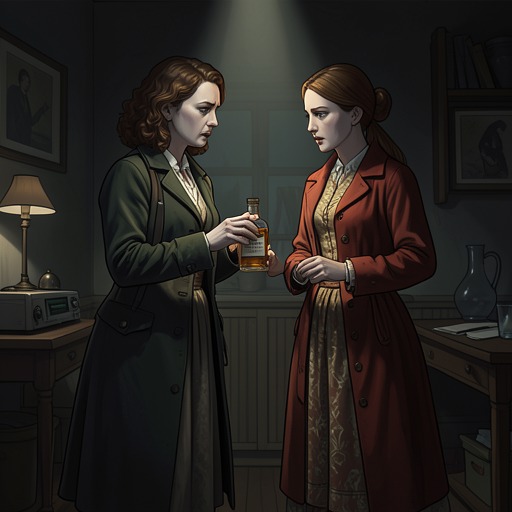
Pecola and the women upstairs
The Bluest EyePecola and the women upstairs are linked by a rare ease across age and social judgment: China, Poland, and Miss Marie welcome Pecola into their apartment above the Breedloves’ storefront, let her run errands, and do not despise her. Their relationship gives her companionship and tangible generosity, but it does not erase the vulnerability of a child moving among adults whose lives are far removed from conventional respectability.
Identity and Setting
China, Poland, and Miss Marie live in the apartment above the Breedloves’ storefront. The women are sex workers, and the narrative presents them neither as figures of polished respectability nor as repentant versions of it. They are direct about their lives and share an unguarded familiarity with one another. Pecola visits them and runs errands; the arrangement makes their upstairs rooms a place she can enter and a source of attention absent from her own household.
The women’s reception of Pecola is defined by a striking absence: they do not despise her. Their welcome matters against the broader pattern of the child being exposed to rejection and humiliation. With the women, she is not treated as an object of contempt. Their friendship is not described as a rescue or a substitute family, but it gives her a small, recurring place in which she is accepted.
A Child Welcomed Among Adults
The women are friendly, though slow to begin talking. Pecola often takes the initiative, especially with Miss Marie; once drawn into conversation, Marie can be difficult to stop. This detail gives their visits a particular rhythm: the child approaches, asks, and listens, while the adults respond in their own time. Pecola’s place is not merely that of a silent observer. She makes contact and is allowed to participate in the women’s conversation.
Marie invents stories for Pecola because she is a child, but these are breezy and rough rather than protective, sentimental tales. The women’s way of speaking does not disguise their adult world. The narrative emphasizes that they are at ease with Pecola as they are with one another, not that they transform themselves into conventional guardians. Their acceptance thus carries both warmth and a limit: she is included, but within a world that does not organize itself around childhood innocence.
Pecola’s questions also show how she uses this relationship to explore adult life. She asks Marie how she has so many boyfriends and asks whether Marie and Dewey Prince have children. Marie answers that they had some, then fidgets, removes a hairpin, and picks her teeth; the account indicates that the gesture means she does not want to continue. The exchange lets Pecola ask plainly, while Marie retains the right to stop. Their closeness is informal, but it does not make every subject available.
Care and Material Generosity
Pecola describes the women’s kindness to the MacTeer sisters by listing what they give her: pretty dresses, shoes she has more of than she can wear, jewelry, candy, and money. They take her to the movies, and she has gone with them to a carnival. China is also planning to take her to Cleveland. These gifts and outings make the relationship concrete. The women’s care is expressed not only in friendly conversation but in objects, shared excursions, and plans that extend beyond the apartment.
Pecola contrasts her experience with her mother’s judgment of the women. When asked why her mother will not let her into the house if the women are so nice, Pecola says she does not know; her mother calls them bad, but Pecola insists that they are not bad and points to what they give her. The disagreement places the child between an adult rule of respectability and the evidence of her own experience. Her answer does not amount to an abstract defense of the women. It comes from a simple relational fact: they treat her generously.
That generosity has particular force because Pecola is a child whose home life offers little dependable shelter. Yet the narrative does not present the women’s gifts as proof that every need is met. Clothing, candy, money, and outings can make her feel included without changing the larger conditions that leave her exposed. Their kindness is real, and its limits are real too.
Difference, Vulnerability, and Narrative Significance
The women’s frankness distinguishes their relationship with Pecola from the idealized language of respectable adult care. They have no word for innocence, and the narrative imagines that they would not have voiced alarm if Pecola had said she meant to live as they do. That implication marks a gap between their ease with her and the protective boundary a child requires. The text holds the two facts together: the women do not despise or reject Pecola, but their acceptance does not necessarily amount to safeguarding her from adult life.
Their portrayal also unsettles a simple opposition between respectable women and disreputable ones. Pecola’s mother condemns the upstairs women, while Pecola experiences them as the people who give her things and take her places. The contrast is not resolved by declaring the women flawless; rather, the narrative makes the difference between social judgment and lived treatment visible. Their friendship provides care in forms Pecola can recognize, while remaining shaped by circumstances the novel does not turn into a conventional account of adult protection.
The relationship therefore serves as a brief counterpoint to Pecola’s isolation. In the apartment above the family storefront, she finds adults who let her approach, listen to her questions, and include her in their routines. That welcome cannot undo the harms surrounding her, but it shows that rejection is not the only response available to her. The women’s significance lies in this limited, tangible tenderness: they make room for Pecola without making their world into something it is not.